

Every so often a book lands in your hands just when you need it.
I happened upon The Art of Attention: A Poet’s Eye, by Donald Revell, the other day. I had started it at some point because it was underlined for several pages, but in the daily onslaught I had somehow lost track of it. But here it was and I had the time to read it, so I started again.
But before I get to what I found so sustaining in this little book, a bit of backstory:
I have had a horrible winter/spring, and have found the desire to write anything has simply evaporated. My chronic fatigue and fibromyalgia flared, and I tumbled down the rabbit hole of pain and panic again. It isn’t my first rodeo, so I should know how to handle these flare-ups, but there have been too many too close together for too long. I’ve lost my equilibrium.
Feeling unmoored in all ways, I’ve felt more so in my writing. What is this drivel? I think, looking at pathetic lines on the page. More importantly, why the effort when everything takes so much effort?
I have joined a lovely group of poets that meet monthly, and suddenly I am aware of what good poems are. And I want to write them. But the more I try, the more stilted my efforts. It is as if I’ve lost my innocence, my native language. What is a poem, anyway?
A poem, according to Revell, “is a plain record of one’s entire presence….the poetry of attention is acceptance….the poetry of attention proposes a heroic unoriginality whose entire faith rests in the tireless originality of the real.”
Something in me accedes—yes! I like in particular the word “plain” in contrast to “entire presence.” Plain is serviceable, every day, yet entire presence is all that we have, it is everything.
I think of some of my favorite poets, and notice the plainness of their language. Here is an excerpt of Denise Levertov’s poem, “In California: Morning, Evening, Late January”.
In California: Morning, Evening, Late January
Pale, then enkindled,
light
advancing,
emblazoning
summits of palm and pine,
the dew
lingering,
scripture of
scintillas.
Soon the roar
of mowers
cropping the already short
grass of lawns,
men with long-nozzled
cylinders of pesticide
poking at weeds,
at moss in cracks of cement,
and louder roar
of helicopters off to spray
vineyards where braceros try
to hold their breath,
and in the distance, bulldozers, excavators,
babel of destructive construction.
Banded by deep
oakshadow, airy
shadow of eucalyptus,
miner’s lettuce,
tender, untasted,
and other grass, unmown,
luxuriant,
no green more brilliant.
Fragile paradise.
. . . .
At day’s end the whole sky,
vast, unstinting, flooded with transparent
mauve,
tint of wisteria,
cloudless
over the malls, the industrial parks,
the homes with the lights going on,
the homeless arranging their bundles.
. . . .
Who can utter
the poignance of all that is constantly
threatened, invaded, expended
and constantly
nevertheless
persists in beauty,
tranquil as this young moon
just risen and slowly
drinking light
from the vanished sun.
Who can utter
the praise of such generosity
or the shame?
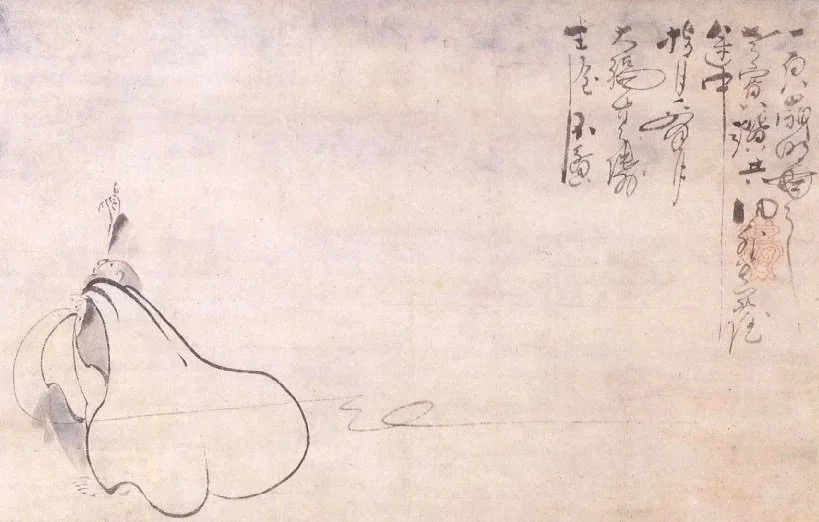
Hotei Pointing at the Moon, an ink-on-paper hanging scroll created around 1650 by the Japanese Zen monk and painter Fūgai Ekun (1568–1654).